
Exploring emerging tech for response

Serve On explored tech, robotics and AI in the emergency response sector at an in-depth, hands-on event. Gavin Johnson talks us through the day...
AT the Bristol Digital Futures Institute on Wednesday May 6, we explored a number of emerging technologies which collected data and created life-like scenarios, giving food for thought on the future of emergency response.
I spoke to experts as I took a tour through the no-expenses-spared facility, trying out the latest tech and discussing how Serve On can help in the institute's research.
Room one
The first facility was a super-cinema with an array of cameras, sensors, speakers, remote heart rate monitors and other data collecting devices. It was a high tech room of which there are only a few in the world.
The purpose of this cinema was to record changes in eye movement and body language, as well as reactions to different types of media shown on screen. One example of this type of technology was to test control room operators of nuclear power stations in emergency situations to pre-determine their stress level tolerance, prior to an actual emergency. This provides valuable insight into potential candidates before appointing them for the mission. This kind of observational equipment and software will be crucial to training and assessment programmes for high risk, high stress roles.
Room two
This room had multiple Virtual Reality (VR) headsets which I tested out. They ran a programme which demonstrated how you can freely take body parts out of a 1:1 scale body, something which could be used for anatomy training for surgeons.
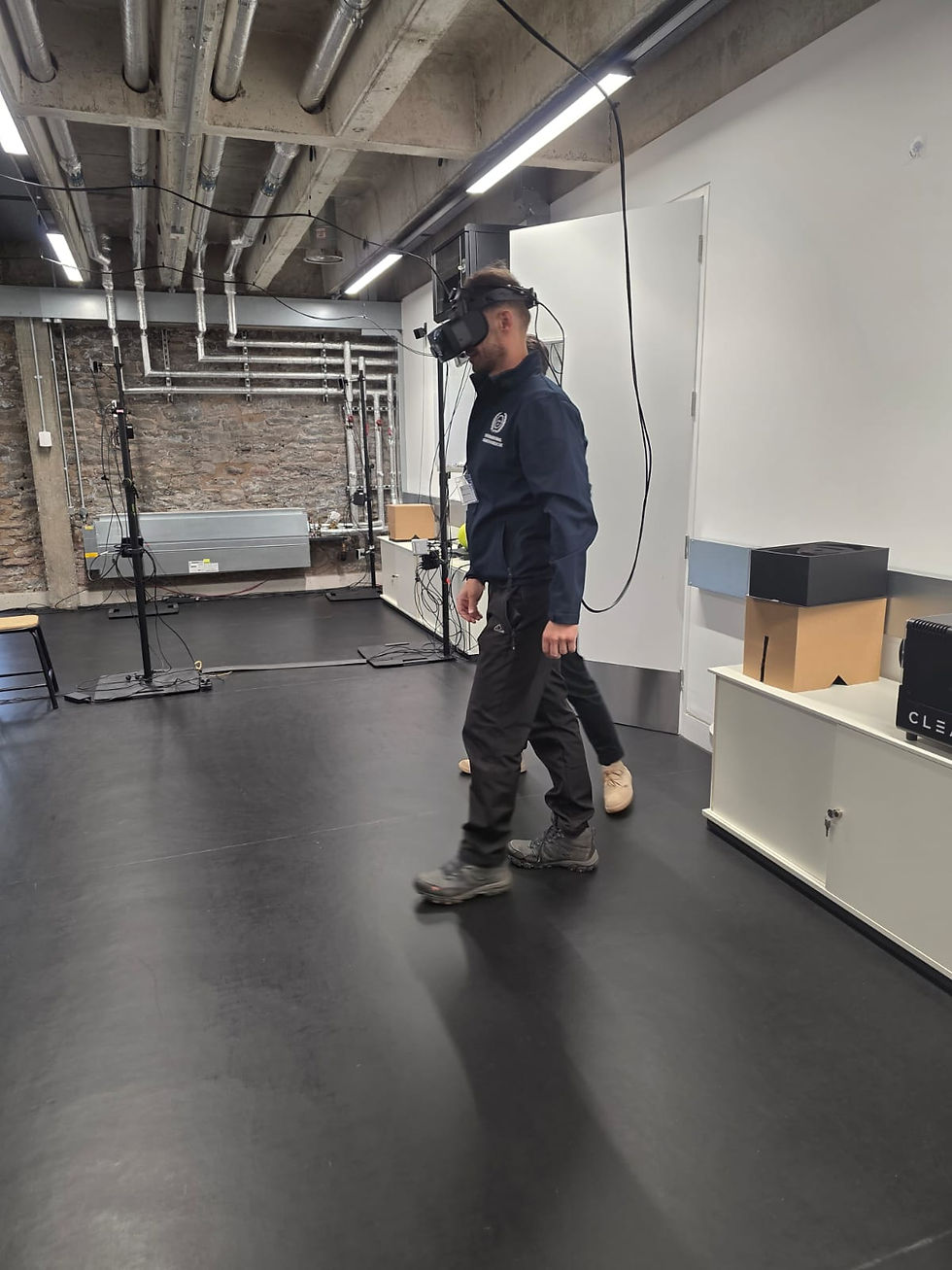
I spoke with the experts about how this technology could be used in conjunction with AI to create rescue training scenarios or tests, where you have to use your hands to use tools for breaking and shoring, or simulate crawling through confined spaces, with realistic outcomes. They reckoned it was definitely something to explore.
Furthermore, it could be combined with the technology in the first room to gain feedback from the user under stressful situations. Although this may not replace physical training, it could be a valuable and an infinitely modifiable addition.
Room three
The third room was a 360 degree room with 3D seen through glasses, an immersion experience where you and a team can interact via a controller.
They demonstrated a scenario where you are a firefighter and arrive on scene at a large hotel building with multiple gas leaks. You have a drone with you - can chose to either fly the drone yourself, or let the drone fly automatically via AI, which allows you to also enter the building along with the drone.
It presented interesting results and some thought-provoking choices around trust and drones. Again, while it doesn't replace real life drone flying and training, it could be a useful addition to any programme.
In addition, this room could be used to simulate an operations room with multiple users - with some communicating and others simulating a ground-based team using the VR headsets.
Takeaways
It seems the possibilities for search and rescue training are vast and definitely something to consider for the future. As tech advances, this type of training and feedback can only get better.
At the end of the day, we all participated in a discussion which gave the centre feedback on the technology they showed us. Whilst it seems the barrier for most organisations would be budget constraints, the day showed what tech is out there and ideas of how we could use it in the future.


Comments